Episode Transcript
[00:00:01] Speaker A: Welcome to Energy in the Room. I'm Katie. Join me as I sit down with the inspiring voices shaping our energy future. Together we'll share real stories, big challenges and honest advice from those leading the transition.
Let's dive in.
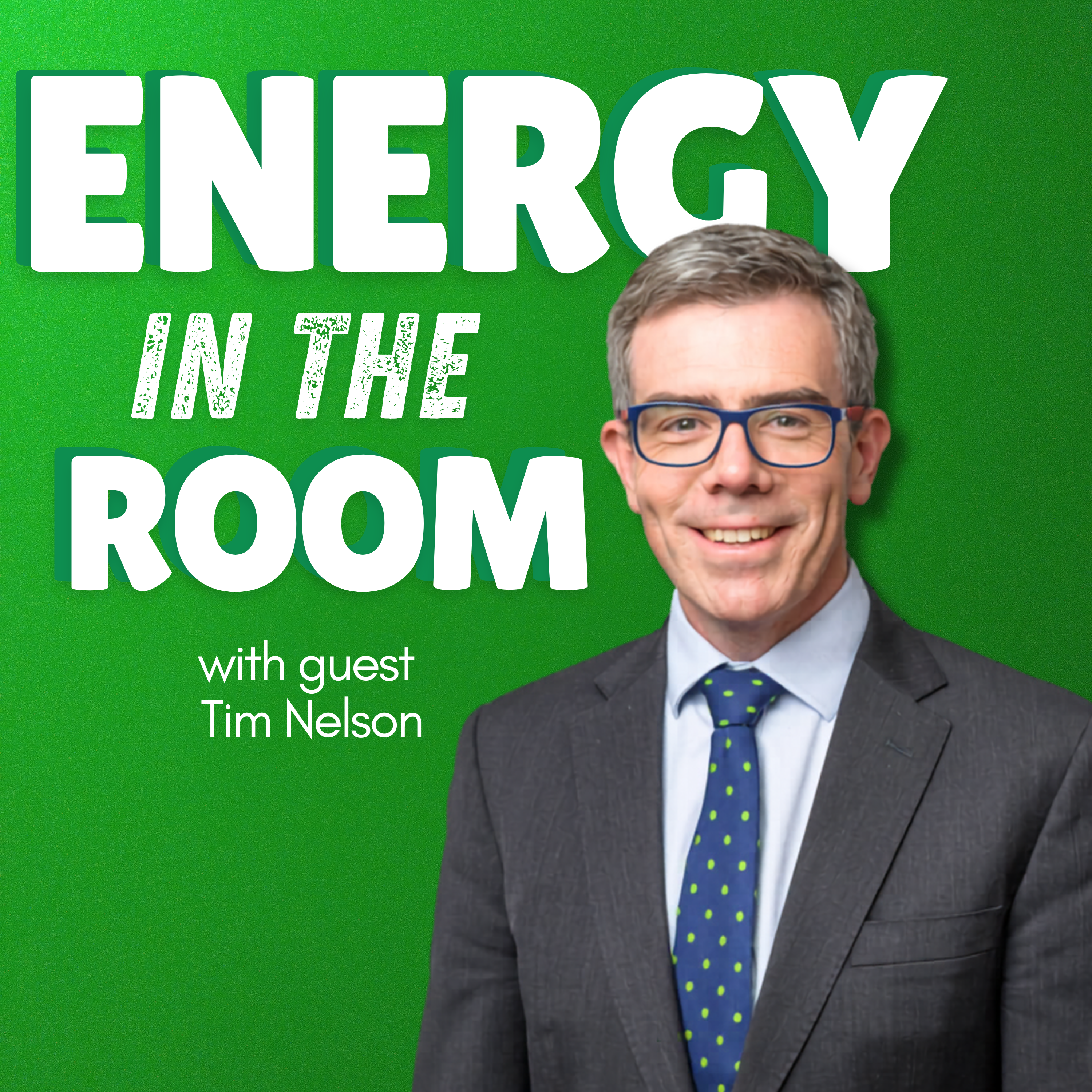
Hello, Tim.
[00:00:22] Speaker B: Hello. Thank you for having me.
[00:00:24] Speaker A: You are welcome. Thanks for coming in.
So, Tim, by way of introduction, Tim is one of Australia's leading voices on energy markets, markets, climate policy and the transition to a net zero economy.
Tim's an economist who's currently serving as Chair of the Independent Review of Australia's nem, delivering what's been labelled as the Nelson Report.
Today, Tim and I will be talking about what's in this report, the methodology and your take on tackling a skill shortage.
So for those that maybe have not gone through the review with a fine tooth comb, can you just tell us what is the report and what are the headlines?
[00:01:03] Speaker B: Sure. So it's probably worth just getting in the time machine and going back to 2024.
I think what governments realized was that a lot of the policies that had been introduced to support new investment were being done on government balance sheets. And I think that they were a little bit uncomfortable with taking on that long term risk associated with effectively inducing all of that investment in the electricity market.
So they reached out to myself, Paula Conboy, who's the ex AER chair, Phil Hirshhorn, who's an ex BCG partner, and Ava Hancock, who was instrumental in designing the New South Wales Energy Roadmap with Matt Keane and asked us to conduct a review of the NEM.
That was at the kind of end of 2024. And so throughout 2025, that's what we were basically doing. We were going out and meeting with a bunch of people. We met with hundreds, if not thousands of people.
We really did put a lot of emphasis on that stakeholder engagement.
And our job was really to say, well, what should the National Electricity Market look like once the Capacity Investment Scheme is fulfilled in the next couple of years?
So our first task in all of that was actually to define what the National Electricity Market is and what it's not. And that was actually something which I know it sounds obvious after the fact, but it's actually something which isn't really done very often and the NEM means different things to different people.
So in the first instance that was our task really to define what we were going to go and have a look at.
So we defined it across timeframe. So we thought, well, let's define it as the short term operational market. So that's where all the generators are bidding into the market, retailers are buying that energy and supplying it in real time to customers.
The most overlooked part of the market though is the derivatives market, that medium term risk management function. And that's where we spent a lot of time. And again globally it's really overlooked.
As an academic as well as an industry practitioner, you'd be surprised just how much that segment does get overlooked. And then the last element that we defined as being kind of within our terms of reference related to the NEM was the long term investment signal, which I think is what the Commonwealth and the States really wanted the review to look at. What does the long term investment signal look like beyond the capacity investment scheme?
So once we defined what those things looked like, then we went, as I said, and met with a bunch of different people and we came up with some common themes of what we thought the market wasn't necessarily best placed or prepared for.
The first of those was the transition behind the meter. So we're seeing a lot of people put in solar, a lot of people now putting in batteries.
And the term that we used to describe that phenomenon was there was a lot of now what we call hidden participants. So people who are generating their own energy, people who are then discharging their battery into the market. But the market operator AEMO and the rest of the industry didn't know what they were planning to do every five minutes. So that hidden participants was something that we thought was really important to look at the next one, which again after the fact, I know sounds obvious, but not so obvious is the fact that we're moving to a more weather dependent system and that just changes the nature of the risks that the risks in the system used to be. It's a really hot day, we've got a whole bunch of coal fired plant and some gas plant and one of them might fail because it's so hot and they trip and then all of a sudden you don't have enough power.
The risk profile in say 10 or 15 years time probably looks a lot more like you have a prolonged series of days where you have below average wind, not as much solar in the middle of winter, and you've still got those very high peak demands because everyone's using their heater.
So that changing risk profile was something else that we focused on.
And then the final component was this long term signal. And what we heard loud and clear is a pretty basic problem, which is most industrial customers and retailers don't want to sign a long term contract.
But to get the big Kind of licks of capital, the big amounts of equity and debt into the heavy fixed cost generation infrastructure.
You need to have long term certainty. So if customers aren't prepared to sign long term contracts, something needs to bridge that gap. And that's what we call the tenor gap. And so our recommendations really went to trying to solve those kind of particular problems that we'd identified.
We put out a draft report in the middle of the year and we got some pretty good feedback from both ministers and stakeholders. And then we spent the second half of the year really going into much greater detail about how our recommendations might look.
The report is quite long. You know, it's a couple hundred pages and there's some appendices that go into even more detail.
But I've had to say there's. There's probably only three key recommendations that, that I'd say are really important for everyone to think about. The first is you've literally just, you're
[00:06:04] Speaker A: about to answer my next question.
Like no, exactly. Like it is a long report. And um, yeah, if you could pick out things that are like really important for people to consider and look at. That's what I want to know.
[00:06:16] Speaker B: Um, absolutely. So the, the three things that I'd point to.
The first is the recommendation to make all of those behind the meter resources visible.
Now in the draft report we said that they should become dispatchable. So in other words, they would tell AEMO every five minutes, this is what we intend to do in the next five minutes. And then they'd be held to account. If they didn't do it, then they'd be in the same way that a large scale generator has to comply with that, they'd be in a bit of trouble.
We walked back in the final report and thought, actually that's not really necessary at all. All we need to know is visibility.
So in other words, let's say you've got a battery. Your battery is part of a big virtual power plant run by an Origin or an AGL or an Amber or somebody like that.
The obligation would be on origin in AGL or Amber to tell the market operator. We think in the next five minutes this is what our fleet of batteries will do. That way AMO can adjust its forecast and you get a much more efficient allocation of resources. So not too much generation, not too little generation, you know, kind of that just the right amount, you know, the Goldilocks amount.
The next key recommendation that we came up with was about this risk management function dealing with more weather dependency.
And again, it's not A groundbreaking kind of recommendation at all. But it goes to the heart of as a panel, we thought our job was not to necessarily solve all of these problems, but to create frameworks by which the industry could keep coming together to solve these problems because they will evolve over time as technology changes.
So the recommendation is really simple, which is once every few years, generators, developers, retailers, civil society, consumers, they get into a room and they agree these are the key contracts that are useful for managing risk in the new system.
So historically there's been baseload swaps, there's been caps, those types of contracts in the future that might look really, really different. But again, rather than us, as the panel saying, here's the answer, let's create a process by which the industry itself can come together to define what those contracts look like.
And then the related recommendation is this long term entry mechanism.
So we called it the Electricity Services entry mechanism.
I'm sure he wouldn't mind me telling you this, but Minister Bowen did tell us it was the worst name he'd ever seen suggested for anything in the energy industry, which is saying something because there have been some shockers.
[00:08:48] Speaker A: Why is that so bad?
[00:08:49] Speaker B: Oh, look, I think ESEM just kind of, just doesn't kind of sound at all in any way interesting.
But the ESM is a fairly basic conceptual type of framework, which is we need more bulk energy, we need more megawatt hours, more wind, more solar, that type of generation.
We also need more storage, so some shaping to be able to take the surplus, deploy it back when there's less renewables. But then we also need some firming, so the type of generation that can continuously dispatch for very long periods of time.
And so what this mechanism would do was it would effectively stand in for customers by buying those long term contracts, but the same types of contracts that are defined by that industry process. So it's industry itself defining what those contracts look like. This body buys those contracts from new entrant generators and then as you roll forward in time, it sells them back to the retailers who then use that to manage the risk that exists in the spot market. So if anything, all we really did is we took the existing market design and stretched it so that it was more an investor type timeframe.
[00:10:01] Speaker A: Yeah.
So just back to the esem, the
[00:10:06] Speaker B: worst name in history.
[00:10:08] Speaker A: So what's the interaction between CIS and ESEM and what do you see the differences and benefits are for either?
[00:10:16] Speaker B: So I think the key issue globally, if you look in the literature around what's become known as the hybridization of Energy markets. So you've got these short term markets and then you've got these long term policies to bring new investment in.
They don't talk to each other.
So if I'm the government and I'm buying lots of energy in the market, I don't really have any natural use for that energy because I'm not participating in the spot market, I'm not a retailer, I'm not an end use customer.
So rather than having a government entity revenue underwrite or do one of these other types of things, it's literally saying no, no, we're just going to stand in for the customers until they need the energy and then on sell it back to them. So it's a much simpler type of process.
Means that governments aren't on the hook for, you know, effectively underwriting all of that. It stays within the market and all it's really done is taken the existing design and stretched it so that it's an investor timeframe. It's not, I know kind of my fellow panel members would probably say it is more complicated than that, but I think in a nutshell that's kind of what it's trying to do and that's different from what's been done globally because most of the things that have been done globally are really the government being the counterparty to the generation and in this case it's much more consistent that it's around the consumers themselves and they benefit longer term from having that new entrant supply, which again creates a much more efficient outcome and a better price for them longer term term.
[00:11:52] Speaker A: Okay, and probably like you say, I think you're doing a really good job of putting things in a nutshell and I imagine this answer is pretty complex.
How, you know, there's been these reviews in the past.
How do you see turning these recommendations or at least pushing them through to more than just recommendations and actually implementing and having an impact?
[00:12:21] Speaker B: Yes, Such a good question.
And so at the end of last year, when we presented to the ministers in December, we were really pleased that, you know, all of the ministers lent in and supported implementing the recommendations.
[00:12:33] Speaker A: Actually that was, yeah. Just to take a step back. What is the status of the review now, given that conversation in December?
[00:12:41] Speaker B: Yeah, so the panel itself is now disbanded. So we're kind of, we've all moved on to the band's.
[00:12:47] Speaker A: Moved on.
[00:12:48] Speaker B: Yeah, exactly.
We're all trying to find, you know, kind of our next kind of gig so the, the bands will kind of reform and go and play different concerts.
But we presented to ministers the final report.
We were really pleased that ministers leant in and agreed to the major recommendations, the ones that I've just kind of spoken about.
And so now there's a bunch of people led by the Commonwealth who are being tasked with going and implementing those recommendations.
And the key recommendations that they'll be implementing over the next year or two will be defining those contracts, running that process so that industry comes together to look at that, setting up the electricity services entry mechanism so that it can start kind of creating that environment or that investment signal for shaping energy and firming.
And the panel's very, very happy to continue in the background, you know, providing, you know, helpful advice where governments want it. We're also cognizant that we, we had a task, we, we kind of did that, that, that, that task. And now there's a, another group of people whose job it is to implement it. We don't want to make their life difficult by providing running commentary on how that's going. But we are also very happy for, for, you know, if people have got questions about, well, I wonder what Tim, Paul or Phil and over were thinking when they were always happy to answer any phone calls and take people through where we got to.
[00:14:19] Speaker A: Yeah, yeah, I see. So you're kind of in this position now where you have to hand over the reins and you've done your piece and you can advise but maybe not have direct say in how.
[00:14:34] Speaker B: Yeah, absolutely.
And I think that's something which, um, you know, we think is we, we understand why that's been done because at the end of the day, the panel came up with a particular blueprint.
Logically speaking, you know, when human beings just, you know, kind of put forward something as this is what we think should be done, there's always going to be the, the suspicion that we'll be a little bit too belligerent and won't compromise if, if circumstances change or whatever it might be. So I think it's entirely reasonable for the panel to say, here's the blueprint or here's the schematics over to you to build the building now.
And we're always around to kind of interpret why the schematics say a certain thing.
[00:15:20] Speaker A: Yeah, yeah, well. And so, yeah, the four of you, had you worked together before in any capacity or was it a new introduction for all of you?
[00:15:29] Speaker B: I think we all vaguely kind of had worked in and around kind of each other before. So certainly I knew each of them. I didn't know them very well and I have to. I'm going to you know, a bit of a shout out to Minister Bowen's office in particular, but also Simon Duggan in the Commonwealth Department.
If we think through, what they really got right was they picked four panelists who have very complementary skill sets.
The other thing that they picked inadvertently is they picked four people who don't really have big egos and are quite happy to compromise.
And so we were really lucky in that instance. From day one, we got on like a house on fire.
Everyone's views were kind of welcome. We discussed things.
Everyone agreed that this would only work if we got stakeholder buy in. And so the early decision to, to kind of see this as almost like a co design process rather than it's just the panel, let's go and meet with all of the large energy users, the consumer reps, the generators, the retailers, the clean energy industry, the developers, everybody.
And we thought that by doing that we would get a really good outcome because instead of it being seen as the panel as this kind of eggheady kind of thing, kind of looking down, kind of. And here's our kind of sermon from the mount. Here's our blueprint.
No, no, much more around.
Here's what we've all kind of come up with together. And that just, we think means that it's much more likely to stick through the implementation.
[00:17:10] Speaker A: Yeah, yeah, yeah, okay. And. Sounds a bit airy fairy from me, but it sounds like you enjoyed it might be wrong, but you enjoyed every second of it.
[00:17:20] Speaker B: It's been the best.
[00:17:21] Speaker A: So happy to be a part of it.
[00:17:22] Speaker B: Yeah, yeah. Sorry for. I was so eager to respond there. Sorry, I didn't mean to speak over the top, but yeah, you can probably see the enthusiasm.
It's very, very rare in your professional life where you do get to work with such amazing people. And I can't thank not just the other three panelists, but also all of the people. So there was a big group of people from the Commonwealth Department, but also some amazing people from aemo, the aerial, the aamc.
A lot of the state governments had secondes into the process. Not, not all the way through, but just at various points.
But also it was just, it was so. I was so lucky last year to meet so many people in the industry and learn from them.
And I know that probably doesn't, I know that probably doesn't sound like what most people in this position would probably say is their big feedback, but the learning that I had last year was probably the, the most I've ever had in the sense of just being able to understand the different perspectives of people.
So, yeah, if I think back to why I accepted the role in the first place, a lot of it was this notion of, well, if I don't do this now, when will I ever do it? And I'm so glad I did because not only do the four of us think that we've left a really, really positive contribution for governments to now implement, and we do think it'll make the electricity system more efficient and more effective, but also it was just such a great learning experience.
Feel really blessed to have been given the opportunity.
[00:18:59] Speaker A: Yeah. For real.
And now energy in the room is powered by Venova, who are a recruitment company. So I do want to talk about the workforce behind the energy transition. I think when we spoke last year, we had a good chat about the skills shortage.
So just want to get your take on that.
And yeah, I guess where you see the real shortages and where we really need to get our act together to bring the right people through.
[00:19:34] Speaker B: It's such a multi layered question.
What I probably can speak to is just the area where I've probably got a little bit more expertise and background, which is economics.
[00:19:47] Speaker A: Yeah.
[00:19:48] Speaker B: And in the world of economics, there's a really sad reality that it's one of the few disciplines that's seen not only a huge drop off in enrollments, very few people study economics these days, but it's had the biggest reversal of gender diversity of any of the disciplines in the sense that.
And the Reserve bank has done some great work on this. But you know, 3040 years ago, the enrolments at first year university and high school were largely 50% male, 50% female.
I think the latest data was 90% male, 10% female.
And I think part of what we're seeing in terms of some of the policy development, I think not just in Australia, but globally, is a lack of really good training in economics and opportunity cost in particular.
And I think that opportunity cost is one of those things that again, if you're trained in economics becomes the most foundational principle about the way you think about the world. If I do this, then I can't do that.
And I do worry that without that type of thinking, people tend to think, oh, I'll make this decision, it's only $5 million. What does that matter in the grand scheme of things in a country that's worth trillions?
Well, but that's $5 million that if you're spending that on this, then you can't spend it on something else.
And I think that scarcity thinking is probably not sufficiently robust. Through the industry. So I think in the field of economics, we've got a lot of work to do to make it relevant for people in the way that they assess how it will provide them with skills that are useful in the workforce.
On electricity more specifically, I think there's a lot of interest in the transition, but where I think the industry needs far more focus, it's on the kind of the really hard stem aspects of the transition.
Power system engineering, electrical engineering, all of those things that go to the heart of taking a system that was largely a few coal fired power stations, some gas fired power stations, some hydrogen, and then all of a sudden you're in a world where you've got hundreds of wind turbines spread around the country, you've got solar in the same way, you've got battery storage, you've got millions of Australian homes and businesses putting in their own PV and batteries. That's a fundamentally different system and it requires engineers with the greatest of all qualities, which is curiosity. How do I solve this problem? Because you might open the textbook and the textbook doesn't have the answer because this is being done for the first time.
You take South Australia, you got the highest proportion of renewables in that type of system anywhere in the world.
And I suspect that if you asked the average engineer down there, they would say we've literally had to make this up as we go along. We're literally having to solve problems in real time.
That's an exciting kind of part of the industry, but it does mean we need a lot more people with skill sets in those engineering spaces and how we encourage people to see the transition as something not just that needs to be solved, but something that they can actively get in and solve, I think is really important.
[00:23:14] Speaker A: Absolutely, yeah. Is there anything else that you want to cover around the report or the.
[00:23:21] Speaker B: I think just back on the education side of things, I think part of the challenge is that the narrative that's in the media around the transition tends to be quite polarizing. It's either transition good, transition bad, whereas it's a lot more layered and nuanced in the sense that the transition is a great thing because we're giving households and businesses more opportunity to take control of their energy supply, we're reducing emissions, we're preventing dangerous climate change, all of those really great objectives.
But in that, and this is again, kind of me kind of giving you a personal view, I wouldn't want this in any way attributed to the review, but my personal view is that the moment it becomes a very simplified, polarizing Debate, it becomes really challenging to say things like, well, like any transition, there are going to be aspects of it that are hard. Like the engineering side of it, I'm sure is incredibly challenging.
Does that mean it can't be done? No, it just means that you need lots of really clever minds that can solve problems.
And I think rather than focusing on just that polarizing nature of the transition being good or bad, I think we're doing a disservice to younger people who are coming through school and university by not saying no, no. There are some really gnarly challenges that you can help solve. If you are interested. Here's the pathway towards you doing that.
And I think whether it's economics or engineering or law, there are all of these things that are going to be constantly evolving and require people with really adaptive type mindsets.
And I mentioned that quality before. Curiosity. I think that's really important.
How do I solve this problem? How does this work? How can I make it work better?
The more people we can get that into the industry, I think that, you know, we'll be really well placed to solve all of these issues.
[00:25:14] Speaker A: Yeah. Well, you're clearly a very impressive mind, especially when it comes to energy. What is next for you?
[00:25:23] Speaker B: It's a really good question. And if, if I'm really honest with you and your audience at the moment, I've got a mix of fear and exhilaration in the sense that I've never done something like this before. I've never taken a, a leap into the deep end and gone, well, now I need to swim. And I knew in taking this role, the role to chair the review, that it would come to an end and then I would have to find my next kind of thing to contribute.
I think what I'm looking for is something that continues to push forward on that transition.
But I'm also very passionate about some of the issues around equity and the way in which the transition is being delivered. So if I think about tariff design as like a really important part of that, we can't leave people behind that haven't got access to distributed energy resources. So people who are living in apartments, people who for whatever reason don't own their own home, there are some huge barriers to people taking advantage of that clean energy revolution. So I guess what I'm open to kind of thinking about what my next.
I'm currently kind of going through that process. What do I want to do when I grow up, so to speak.
If you ask people who know me well, they'll say that Tim's greatest strength is actually bringing people together.
And whether that's been done in a commercial negotiation sense, a people leadership perspective, or through something like the NEM review, which required keeping a whole bunch of what at first kind of glance appear to be very disparate views and trying to bring them into a position that can be implemented. That's what I really like doing. And I think it's probably something, and you can probably see it, that when I'm talking about meeting with people and trying to negotiate really good outcomes, that is what kind of gets me up in the morning. I find that really exciting.
And so I guess we'll see what happens. But something that allows me to continue to do that, I'll be pretty happy.
[00:27:38] Speaker A: Amazing. Well, thank you so much for coming on.
It's been a pleasure. It's been really insightful because I have to admit, I did not read the full review, so even for me, it's really interesting.
[00:27:51] Speaker B: ChatGPT does do a pretty good job of summarizing it.
[00:27:54] Speaker A: Yeah, I'm getting to the point where I don't know if I trust chatgpt chatgpt with everything now, but no, it's been a brill conversation. So thank you so much, Tim.
[00:28:02] Speaker B: Thanks for having me.