Episode Transcript
[00:00:01] Speaker A: Welcome to Energy in the Room. I'm Katie. Join me as I sit down with the inspiring voices shaping our energy future. Together we'll share real stories, big challenges, and honest advice from those leading the transition.
Let's dive in.
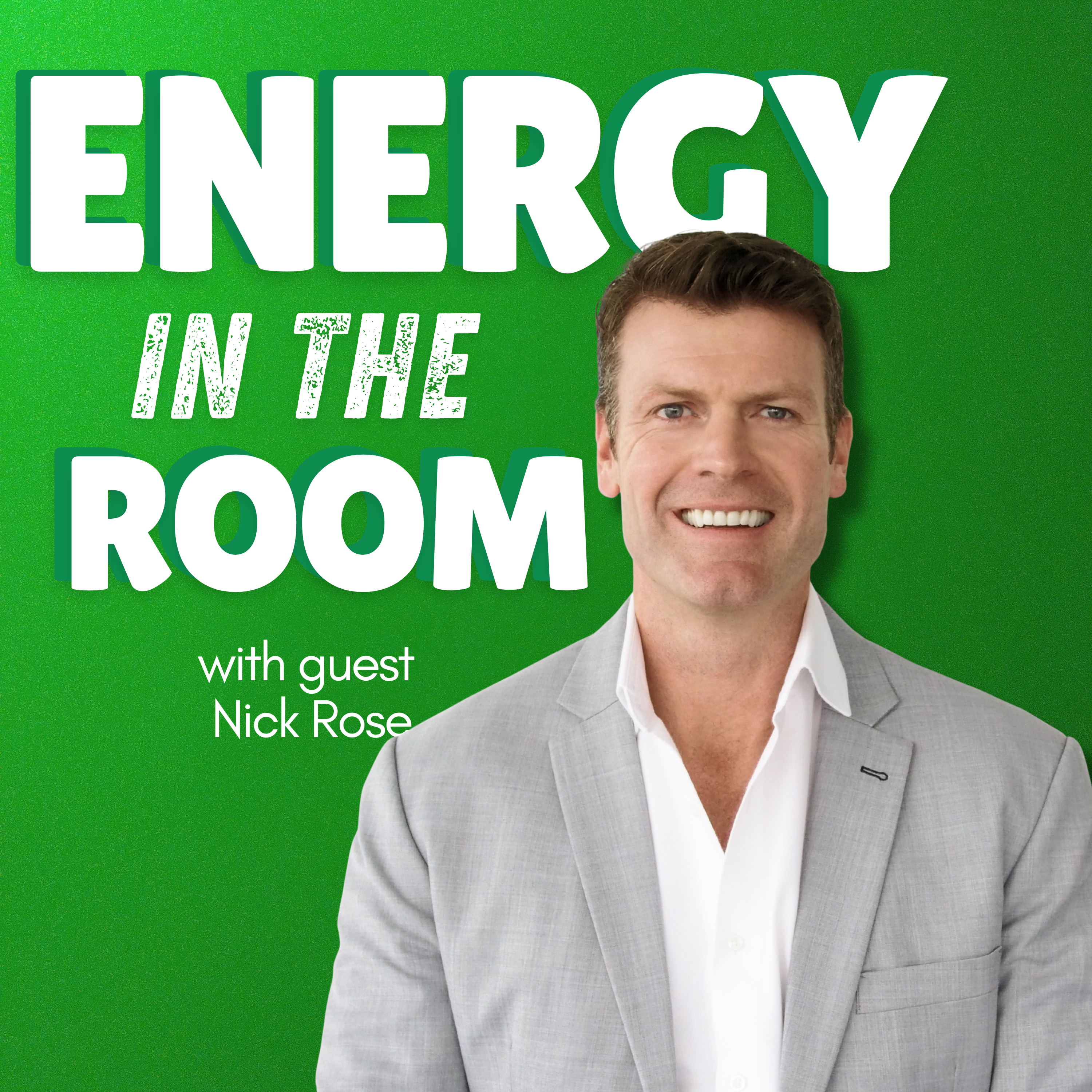
[00:00:19] Speaker A: Okay, so today we have Nick Rose in the room. Thank you for joining us, Nick.
[00:00:24] Speaker B: Thanks, Caddy. Great to be here. My first ever podcast, so well welcome. I've got a prediction it's going to be my best ever podcast, I reckon.
[00:00:33] Speaker A: So you're in safe hands.
[00:00:36] Speaker A: And now to introduce Nick. Nick's been in the renewables sector for 15 years and he is one of the guys who led Firm Power through its very impressive journey, which we will hear about today. Starting off as the first developer in Australia to be 100% focused on large scale batteries. And Nick and the team led through to its mega sale to one of the biggest names in energy agl.
So, yeah, that's one of the stories we want to talk about today and hear from Nick about his own challenges, what keeps him going and his advice to others in the sector.
[00:01:15] Speaker A: So to give the people listening some background, can you give us like your elevator pitch on your career journey and how you got into energy?
[00:01:24] Speaker B: Mm, yeah, I. Look, I started as an engineer and that was really brought on by a great relationship with my grandfather who was an engineer. He rebuilt a lot of Europe. He was in. In the.
One of your countrymen, the raaf.
[00:01:43] Speaker A: Great guy.
[00:01:44] Speaker B: And as a kid, loved my grandfather because as an engineer he could fix every toy that I broke. Right. So he was the hero. He had people come out from down the street trying to fix his toys or their toys. He'd fix them for them and that was inspiring. So that's what I thought. An engineer was a guy that fixes toys. So as a kid I'm like, oh, I need to be an engineer because this is the coolest thing ever in the world. Yeah.
I probably realized later in time that maybe building bridges and airports and things probably wasn't as sexy as that.
[00:02:17] Speaker B: But that drove me to be an engineer. And then at the time I was old enough to start thinking about what happens at uni. I went to a careers day and one thing they turned out and I got really inspired by a brand new course, becoming a solar engineer. I thought that sounded pretty cool.
So I went down that path and started a journey here in Australia. Just to give you a really quick snapshot, you know, worked in Australia then. That took me opportunities to go overseas because the solar market boomed at the right time. So it was, I Was on the rocket ship and went to Singapore, spent time in the Middle east and then back to Australia.
And that's when I got back into working with Firm power. And as you said that that all wrapped up really nicely with, with the acquisition by AGL last year. So very nice. That's where it all began.
[00:03:07] Speaker A: And going back to when you went to the Uni Careers day or whatever it was. Solar Engineer. Did you know what solar entailed at the time?
[00:03:18] Speaker B: No, I got sold. This is great for marketeers out there. I got sold on the fact that they at the Careers they were so advanced that they gave us a CD ROM of what the course was about.
[00:03:29] Speaker A: I don't even know what that is.
[00:03:30] Speaker B: Back then a CD ROM was pretty advanced stuff. Right.
And to give one away meant, yeah, they must have a lot of cash. This must be a pretty serious course.
Little did I know that back then it was the only undergraduate course for solar in the world. This is University of New South Wales, so very Advanced Research Center.
And yeah, even by the time that we graduated 2004 now, so it's 20 odd years ago, it's sort of hard to believe but there weren't jobs for solar in Australia, you know, it wasn't a thing. Right. Like sustainability. I remember one of my first job titles was a sustainability engineer and that was a really new word, sustainability. Like it wasn't just like we throw that around now every day. But this is all emerging.
[00:04:17] Speaker A: Quite hard to believe that the university was the first to do that course.
[00:04:23] Speaker B: I had a really rich background in research in solar engineering going back. Like I'm probably going to do them a disservice here, I want to say like through the 80s, maybe in the 70s, solar cells were used by NASA and used on satellites and things like that. So it sort of all started there, but then it just was brewing for years obviously where it was super, super expensive. Then it was starting to come to a point where you could see actually applying solar on planet Earth made sense. And then the course came into fruition and it's built, that's obviously still going now and expanded into renewable energy engineering. And there's a lot of alumni that you see around now in the industry who like me, sort of had a slow start not doing solar specifically because that industry didn't exist, but have all come back into the fold and be able to be the early experts in the field.
[00:05:17] Speaker A: Yeah, amazing. And what was if there was one like a pivotal moment in your career, whether it was early days or recently where you think yeah, that's sticking with me.
[00:05:34] Speaker B: So I guess I've always been. Had a sort of entrepreneurial bent.
[00:05:41] Speaker B: My first job out of uni was actually working in a startup.
[00:05:46] Speaker B: And we did sustainable water recycling projects. Right. Remembering solar hadn't really had its moment yet. So you sort of reinvent yourself. And we would at the time, there's a big drought on in Sydney and so, so water was a hot topic. So we built this, this company up. I was, I was.
[00:06:06] Speaker B: I was young, so I wasn't a founder. I didn't have cash to put into it, but I was sort of the senior engineer, right. What was I, like 23?
[00:06:14] Speaker B: So I really wasn't the senior engineer, but by title I was and I was the only engineer. And we actually, we started with sort of smaller projects and got into bigger projects. And I remember.
[00:06:27] Speaker B: Standing.
We did, we did. I won't name the property, but we were doing the most expensive property at that time in Australia per square meter. It was a home. And we were doing their water. Water tank project.
[00:06:41] Speaker A: Whose home was it? Can't tell me.
[00:06:43] Speaker B: Oh, protect myself from any lawsuits here. I won't say.
[00:06:49] Speaker B: But it was a big hole. We had to dig a big hole for this tank in their front yard, right. Very high profile and the hole was like 15 meters diameter by 3 meters deep.
We dug this hole and it was just. Kept caving in, right? It was just all sand, which you'd think would sound great for digging a hole. But when you're trying to like make a hole that, that survives. So you've got long enough to put formwork in around to build a concrete tank.
It was like that digging at the beach where the walls keep caving in, right. And it wasn't that much money in the job. And you know, I'm sitting there as a young engineer going, I've got like three cranes around me trying to make this work. And cranes are costing whatever they cost, $10,000 a day. I'm going, I'm out of a depth here. Like, I'll be put in a position where I'm just not ready to manage this.
So I mean, I love being out of my comfort zone, but.
[00:07:41] Speaker B: Yeah, I was ready to jump into that hole.
[00:07:44] Speaker A: Let the sun fall off.
[00:07:46] Speaker B: Yeah. So that was my like epiphany of probably a couple of years of doing that where I was like, you know what, I need to make sure that I do my groundwork and I'm not sort of running before I can walk here as a sort of an engineer and go back and get some proper drilling. So that led me to go and look for that more sort of corporate engineering drilling. And one. One thing led to another and I worked. I picked up a job working for lendlease in their sustainability division which was a great place to.
To learn your trade. Yeah.
[00:08:18] Speaker A: So that kind of taught you to. Yeah.
Maybe not put yourself too much out of your debt depth but do you think that has. Has that ever. And it's like there are probably other things as well but has there ever sort of. Have you ever felt restricted in. In like what you do and, and thinking oh that could be a bit out of my depth and a bit more nervous about jumping into new things.
[00:08:44] Speaker B: Look, I'm not that type of personality. Like I happy to be pretty.
[00:08:50] Speaker B: Aggressive and reaching for the stars but I think what's healthy is to also know your own limitations.
So even if you've got a goal and you want to achieve whatever it might be in the professional world, you know, what you don't know I think is really important. And then you pad yourself around that with either people or training or whatever to make sure that you do know what's needed to get to reach your goal. So yeah, I think it's probably certainly not want to present myself as someone that's conservative.
[00:09:25] Speaker B: But being very aware of self.
[00:09:27] Speaker A: Yeah. It's like yeah reaching for the stars but being very considered with that and the journey and how to get there.
[00:09:35] Speaker B: It's a delicate balance.
[00:09:36] Speaker A: Yeah. And I guess leads quite nicely onto like you are a startup guy clearly.
[00:09:44] Speaker A: And so that if we move on to firm.
[00:09:50] Speaker A: When you were building that team. Well actually let's go back. Like can you just tell us a bit about the start of Firm Power and the early days, like the first year or so. Yeah, what that looked like.
[00:10:03] Speaker B: Yeah, yeah, yeah. It was a good, it was a good start. The story of Firm Power. I.
I'd been working abroad for about eight years and had sort of manufactured you in Dubai.
[00:10:12] Speaker A: Right.
[00:10:13] Speaker B: I was, I'd come back from Abu Dhabi. Yeah, it's been a couple of years working in Abu Dhabi and then prior to that I was in Singapore.
But most, most of that was doing projects around Southeast Asia and that was all solar related.
And then I came back and manufactured a sabbatical here for myself having just needing a refresh and did a working sabbatical down the south coast of New South Wales and then needed to.
[00:10:43] Speaker B: I needed to find work. So I made a call to Chris Wilson and met with him and Simon Ingram who at the time had already started Terrain solar.
And that was a solar farm business that was on its journey and they had a great vision to start up a. A battery solely focus, as you'd said in your introduction, developer looking at battery projects, which again, it's funny how time moves, right? That was 2019 and back then only, what, six years ago, no one was really focused that much on batteries. Right. It was still pretty new.
So look like the story. I knew the guys loosely because I'd actually failed an attempt to buy one of their solar projects when I was working in the Middle East. So that's how we got to know each other then.
[00:11:34] Speaker A: You were the man for the job.
[00:11:35] Speaker B: But the rapport obviously was good enough to suggest that I was. So they took me on to run that operationally run the business.
[00:11:45] Speaker A: Amazing.
[00:11:46] Speaker B: And it was great fun to get started. But yeah, I mean, it was a proper startup. I remember going to that first interview and it was not an interview, it was more of a chat, but it was like, hey, basically we're founding this company on the strength of a piece of paper which shows some sort of generic support from Endeavour Energy at the time in Western Sydney there and the.
[00:12:07] Speaker A: Network.
[00:12:10] Speaker B: To try and look at doing a battery project together. So there wasn't a lot of sort of, I say, hard substance behind it, but that's like a lot of startups. But you subscribe to the vision and the dream and looking at the sort of the macro trends and knowing that the timing was right. So that's how it all began.
[00:12:29] Speaker A: And I think there's one thing being part of the founding team of a startup, but then also doing it in a space that is like you are a new player, you're one of the first people doing it. So there's got to be a certain, there's got to be drivers there.
So when you were building the team and growing the business and striving for success, what was like, what kept you going in the challenging times? Like, what was driving you?
[00:13:05] Speaker B: Yeah, yeah. I think I can probably speak on behalf of our whole team when I say this. And we weren't complicated about what we were trying to do.
[00:13:15] Speaker B: You know, a lot of people think about starting up a company and the vision is like, you know, having a money fight after five years and retiring.
We were just looking to do some cool projects. We wanted to see this battery evolution and be a part of it, try to get batteries. At that stage, we were really looking at the distribution network, so really trying to get batteries into the distribution network, which we thought was technically the right place. For them to be in terms of like their benefit to the grid and get projects up and, and running. And that was enough of a driver.
I think the passion that we all had to see projects into operation was what. When times get tough, and they always were tough and a startup you just look at each other and go, why are we here?
And it's to see projects come to fruition.
[00:14:07] Speaker A: Yeah. And I think, yeah, that's definitely, I think, just saying.
Yeah, we just wanted to build cool projects that everyone that we've met at Firm gave off that vibe of like, we just. It's not that. Yes, it's challenging and. But really it's not that complicated. We just want to build cool stuff.
[00:14:26] Speaker B: Yeah.
[00:14:28] Speaker A: Which is fun.
And then I would say that like, yeah, the acquisition by agl, was it like is a success for Firm and the team and.
[00:14:40] Speaker A: Success is a word that gets thrown around all the time.
What would you say success looks like to you? And did that change from 2019 to 2025?
[00:14:52] Speaker B: Yeah, yeah. I mean Duncan McDonald, who was. He started, we started together with Firm and he was the cto.
[00:15:02] Speaker B: We talked about this in terms of that moment where you're sort of there on your first day and like, what do you want to do?
[00:15:07] Speaker A: Where are we going?
[00:15:09] Speaker B: So we sort of came up with our sort of secret handshake and our pact to just get a project up and running. Let's just start with that. Simple. As I talked about that earlier and that was, I think, how we in our heads define success. So kept it simple but focused and you know, that was, that was, that was enough. Now it's funny how I look back on that, right. Because we were very much a front end developer of projects and then the projects now with agl, so the projects will be developed by agl and so.
[00:15:42] Speaker A: Well, I'll.
[00:15:44] Speaker B: I still need to see that success. It's just that it's not in my control now, which is fine.
But there's a long gestation period for these projects so I'll still feel that success when. When they're built.
[00:15:55] Speaker A: Yeah.
[00:15:57] Speaker B: So whilst that wasn't sort of happening in my tenure, I've had to look back on it and then go, in retrospect, what do I see as success? And I think, I think.
[00:16:09] Speaker B: This is gonna sound really cliche, but.
[00:16:13] Speaker B: Success is about happiness. Right. And that's probably an adage, you'd use that in life. Right. And you're gonna use that in your career.
And if you know it's relative to yourself though, what's happiness to yourself. And I'm not. I don't think of happiness and sitting by a pool drinking margaritas all day. I'm the kind of guy that likes to work. I like to see things achieved. I like to see projects come to, to an end and I like to see people around me enjoy that and grow.
So I think if I look back on Firm Power, I can look back and go, yes, for all those reasons, I can define it as successful.
[00:16:48] Speaker A: Yeah. And I think if you look at the people in your team like you gave them an experience in their career, that's like invaluable.
And yeah, as recruiters, obviously we want to always talk about the team and the hiring process and the people that you had there.
[00:17:09] Speaker A: And I do think that scaling teams can be really difficult, especially for people that.
[00:17:16] Speaker A: You know, you can have a vision on paper and you might be an engineer or you might be a finance professional, but that doesn't mean that you know how to create a team where everyone's gelling together and you've got the right skill sets, you're hiring the right people at the right time, which is the age old issue with project work.
So.
[00:17:39] Speaker A: From your perspective, what would you say are like the top ingredients that you looked at when you were hiring and building the team?
[00:17:50] Speaker B: Yeah, I, as a confession, I used to get quite nervous about hiring people. This is probably pre firm Power. But in my career it's a hard thing to know how to get right. And you have to get it wrong a few times, I think to learn what makes a good for a good hire.
[00:18:07] Speaker B: But you know, it's about culture and it's about getting that right. And everyone has their own culture. Right. Like you can't textbook define culture. We were at Firm Power.
We're a small group of guys when we started with just guys, you know, we like to eat Chinese food, we like to do active stuff, we like to not take each other, ourselves too seriously and have a joke, but like to think out of the box and work hard. So it was like when you're hiring and you're trying to build an environment where everybody's happy and if they're happy, they're working hard, you're trying to match that culture with the people that you bring into the company.
So we would analyze potential recruits in that aspect.
We weren't necessarily looking to be, you know, crazy diversified or anything like that. If anything, we're trying to, it was, I was pretty sacred on, or kept keeping the culture sacred because, you know, if you bring people in like any Kind of Victor sport team that subscribes to that. It's just a lot easier to.
[00:19:13] Speaker B: Get people, keep the wheels rolling. So I'd be quite annoying, I think, to some of my other staff who were hiring. I'd also always insist that I was. I had a sort of final interview with. With everyone.
[00:19:25] Speaker A: Yeah.
[00:19:26] Speaker B: And I wasn't going in to check how good they were at engineering or project management. I'm looking to see if they're going to be a personality fit within the group.
[00:19:33] Speaker A: And was there ever an occasion where someone would get through the process and everyone's very positive and then they met you and you.
It was a no from you.
[00:19:43] Speaker B: Yeah, yeah, yeah. There's a couple. There's a couple.
[00:19:46] Speaker A: But that's the point of why you were involved.
[00:19:49] Speaker B: And, yeah, I felt sorry for my guys because it's hard enough to find good talent. Right. In the industry and they've gone all the way through.
[00:19:56] Speaker A: Yeah.
[00:19:56] Speaker B: And then I've just been a bit like, I don't think that's going to work.
[00:20:00] Speaker A: Yeah. And it's a feeling.
[00:20:02] Speaker B: It's not a fault of the person or the candidate, it's just. It's a matchmaking exercise.
[00:20:06] Speaker A: Yeah, yeah, yeah, yeah, definitely.
[00:20:10] Speaker A: And with that, like, what advice could you give to other.
[00:20:17] Speaker A: Leaders or managers when it comes to hiring?
[00:20:24] Speaker B: I think one tip that sort of came to me later in my career or has come to me later in my career, is with hiring. I think we talked about that screening process.
Once you've got people in the team.
[00:20:41] Speaker B: You'Ve got to actively work to keep them in the team.
[00:20:45] Speaker B: I remember sitting down doing company budgets.
Super exciting stuff.
But you look through at what you.
[00:20:52] Speaker A: Think over a Chinese takeaway.
[00:20:53] Speaker B: Yeah. Well, that would have made it better. Yeah.
[00:20:57] Speaker B: But now you're bashing away at this and you're looking at hiring, building a team, and you're forecasting, you know, new headcount and what they're going to cost and recruitment fees are associated with all of that. And then sort of dawned on me one day, I said, you know, what we don't have in our budgets is this concept of like.
[00:21:14] Speaker B: A retention budget. Right. Like, you know, like it's.
You can have a joke and everything in the office, but in the day, you need to make sure that there's enough budget there to do fun activities. Yeah, right. To keep people wedded to the company and actively work on that, maintain your culture. Same thing I say about a marriage. Right. You gotta keep working on the marriage. It's like that with your team.
[00:21:37] Speaker A: Yeah.
[00:21:38] Speaker B: To maintain that culture and make sure that, you know, it's not all just talk. There's actually action behind it. So we had that.
[00:21:47] Speaker A: We always say hiring does not stop once that person joins the business. Like, retention is absolutely massive. And it's not just first impressions and their first week and their onboarding process. It's. Yeah. Are you delivering on those promises about the working environment and their professional development? Are you delivering on that? And do you actually have a strategy on how to do it? So what did you.
What sort of social things and stuff did you do?
[00:22:16] Speaker B: Oh, look, we had. We had some fun. I remember.
I remember we hired. This is when we were started off, right. We were small, there's five of us, and we hired two guys. We started about the same time, and.
[00:22:30] Speaker B: Poor guys, by coincidence, we'd just finished and we'd nailed a milestone on a development deal. So we were going to celebrate and we went celebrate with. We went skydiving.
[00:22:44] Speaker B: So the two guys. I think we're about four days into the job, we're dragged along, right? We're jumping out of the plane, guys.
[00:22:53] Speaker A: How did that go down?
[00:22:54] Speaker B: All right, look, they loved it. I think. I think it was it. I think we talk about it now and I think it was like, in terms of going back to culture and like, that was what we were about. And it was great to have those guys embrace it.
[00:23:06] Speaker A: Yeah.
[00:23:06] Speaker B: We didn't force them out of the plane. They drove by their own free will mostly.
[00:23:12] Speaker B: But I love that. Great way to be indoctrinated into.
[00:23:15] Speaker A: Yeah. And that is bucket list stuff. Like if you're going to get loyal employees, it's, you know, give them experiences like that.
[00:23:23] Speaker B: We did that. We went. Yeah, we went diving on the Great Barrier Reef with the team later on and, you know, hot air ballooning and stuff like that. We just did.
Well, we thought were fun things and hopefully everyone else thought were fun things. Right. That sort of. I think if you excite the.
The adrenaline, it helps that connection.
[00:23:44] Speaker A: We didn't get any calls like, Katie.
[00:23:46] Speaker B: Can you help me?
[00:23:47] Speaker A: Trying to make me do all this crazy shit.
[00:23:50] Speaker B: We never had anyone leave, so I guess we're doing something right.
[00:23:53] Speaker A: Yeah.
Oh, funny.
So, and then around advice.
What is the best advice you've ever received or just some amazing advice that stuck with you at some point through your career?
[00:24:09] Speaker B: My career, or not even your career.
[00:24:12] Speaker A: And your personal life as well?
[00:24:14] Speaker B: Yeah. I'll tell you one. This has really stuck with me and it was really good advice. First job, first manager, he said to me and he said to me, keep this for life. Because he was a bit older and sort of on his way out, so he felt like he was a real mentor, wise, wise mentor. And he said to me is, keep these things in order and if you do that, you won't have a problem. And it was, number one, your health.
Take care of your health first, be selfish about that and then you put your family second, which sounds a bit, kind of. Most people would think I'll put my family first, but so health, family and then work. Third, very strange advice to get from a boss.
He said, yeah, if you're working for investment banker, they're not going to tell you that, but I'll tell you that. And it's amazing. If you get the first two right, the third one will fall into place. You don't have to think about the third one.
So I've always been focused on that health, health and then family. And I tell that I pass that on. You know, when I speak to people that I are working for me or I feel like I'm mentoring, I do pass that one on.
[00:25:24] Speaker A: Yeah, I agree. And I think if you look after your health, everything else comes as a byproduct that you'll be a better father or a better partner or whatever it is. And I think we're really big on that at Precision and Vinova. I think if you spoke to our MD Simon, he would say, yeah, health, family, work.
And for us, we have an incredible culture and it emanates through. So it's obviously what you did with the team at FERM and your other roles as well.
[00:25:58] Speaker A: And.
[00:26:00] Speaker A: Just moving on to the renewables landscape at the moment.
[00:26:07] Speaker A: I'm sure. Yes. As I suppose we can see from like the journey of 2019-2025 and how many more battery players there are and just renewables developers there are in the market now. It's like it's changing quickly. There's a lot of fluctuation.
[00:26:24] Speaker A: So what is your take on the industry right now?
What would you encourage developers to be thinking about?
[00:26:35] Speaker B: It's always hard. Like there's. There's opportunity everywhere, but you got to figure out which opportunity to take. Right.
It's a pretty exciting space to be in the Australian energy market.
Super busy. There's so much going on.
[00:26:49] Speaker B: I think if I reflect on the sort of the firm power success, it was about getting into a space ahead of time.
So if you're specifically talking about developers, you want to be thinking ahead, you've got to be thinking about what's going to be needed and it's not in six months time, it's further out than that. And trying to position yourself for that. I think if you're chasing what's here and now because of the time it takes to develop a project or develop a business, you might be too late or you'll be just saturated with other competitors.
[00:27:20] Speaker A: Yeah. So gonna be behind.
[00:27:22] Speaker B: Yeah, that's sort of how my ticks. I don't want to give all my secrets away, but that's like this.
[00:27:28] Speaker A: That's why you're here.
[00:27:31] Speaker A: Oh, amazing. And then we always ask our guests, who would you suggest that we speak to next and why? Who do you think would be interesting to hear from?
[00:27:44] Speaker B: Yeah, lots of people.
I'm going to go close to home on this one.
So I'm a non executive director of a business called Liquid Power.
[00:27:56] Speaker A: Yes.
[00:27:57] Speaker B: Talk about emerging sectors. That's low carbon fuels.
[00:28:01] Speaker A: Yes. Talk to us about Liquid Power.
[00:28:03] Speaker B: So Liquid Power is a business that takes a waste wood product and turns it into either renewable diesel, more sustainable aviation fuel.
So out of the electricity segment. Electricity segments obviously taking huge strides and it's kind of on its journey to, you know, achieving what it needs to do in terms of decarbonization.
Yeah. Transport's trickier, electric vehicles are doing a great job and then there's some, some larger scale transport issues which will probably still need a drop in fuel replacement and to do that sustainably. So Liquid Power's attacking that part of the market and again it follows similar suit to Firm Power in that it's very much a development play at the moment and the opportunity is coming in three years time. We could be talking Katie, and we're needing to hire hundreds of people to work for Liquid Power because that space is starting to erupt now I think particularly with the election result here in Australia. There's a lot of support going in behind that.
[00:29:08] Speaker A: Yeah.
[00:29:09] Speaker B: So anyway, to answer your question, the guy who's been running that is development director is Brendan Giles.
I think that space, he could do a lot more justice in speaking about it and the opportunity within and how it makes sense, particularly here for Australia. So he could be very well worth a chat.
[00:29:28] Speaker A: Maybe I'll reach out to him. How do you know Brendan?
[00:29:32] Speaker B: So Liquid Power was born in Firm Power, hence the kind of similes in the name. But when we decided that Firm Power was to be.
[00:29:43] Speaker B: Find an equity investor, we thought it'd be a different style of investor that would be into sort of the electron business versus the what we call the molecules business in Liquid Power. So we spun out liquid power, so that's sort of the legacy there. And Brennan's been with us the whole way and has good experience in this industry.
[00:30:01] Speaker A: Amazing.
All right, Was there anything else you wanted to speak about?
[00:30:05] Speaker B: No, I think covered it. Really? That was.
[00:30:08] Speaker A: That was fun.
[00:30:09] Speaker B: All right. It was pretty straightforward.
[00:30:10] Speaker A: It was good.
[00:30:10] Speaker B: Yeah.
[00:30:12] Speaker A: Oh, thank you so much.
[00:30:14] Speaker B: Easiest thing to talk about is.
[00:30:17] Speaker A: There you go. And I reckon it was a podcast.
[00:30:20] Speaker B: Oh, thank you, thank you.